

Key Takeaways
Magento custom development enables enterprise eCommerce businesses to build scalable, secure, and high-performing online stores tailored to their unique operational needs. Unlike out-of-the-box functionality, custom Magento development allows businesses to create personalized customer experiences, integrate ERP, CRM, and payment systems, optimize performance, strengthen security, and support complex B2B and multi-store operations.
- Custom Magento development helps enterprises build scalable and flexible eCommerce platforms.
- Personalized shopping experiences improve customer engagement and conversions.
- Custom integrations connect Magento with ERP, CRM, PIM, payment gateways, and marketing platforms.
- Performance optimization using Hyvä Theme, caching, CDN, and optimized code improves Core Web Vitals.
- Headless Magento development enables faster, omnichannel digital experiences.
In the age of Magento Open Source, nowadays you have the option to choose between Magento and MageOS. But definitely, Magento is the most powerful eCommerce platform for enterprise eCommerce. With custom development in Magento, it can help you design and develop a Magento-powered website for your business.
Some quick context before we get into the features: Magento holds about 8% of the global eCommerce platform market, sitting third behind WooCommerce and Shopify by raw store count. But raw store count hides the real story. By enterprise value, Magento still leads.
If you’re evaluating whether custom development is worth it for your store, here’s what actually moves the needle in 2026.
Before you go ahead our blog you may be want to explore :
- 10 Best Magento Web Development Agencies & Companies in 2026
- Top 5 Best Magento Development Companies & Certified Services Providers in USA
- Top 5 Magento Development Companies in India (2026)
In this guide, we’ll explore the 11+ best Magento custom development features that help enterprise businesses create scalable, high-performing online stores.
What is Magento Custom Development, Really?
Magento custom development is the process of building tailored features and integrations for a Magento (Adobe Commerce) online store. Instead of using off-the-shelf plugins, developers write custom code to fit your exact business needs. This makes your store unique and perfectly aligned with how you sell.
You need it when your business logic is unique enough that a generic extension either doesn’t cover it or breaks under real traffic.
Key Takeaways
- Magento custom development offers tailored solutions for enterprise-level eCommerce needs.
- Advanced features like B2B functionality and inventory management boost operational efficiency.
- Personalization and Magento speed performance optimization enhance user experience and increase conversion rates.
- Multi-store support and third-party integrations enable business expansion and streamline operations.
- Choosing the right Magento development partner is crucial for maximizing the platform’s potential.
Why Enterprise Businesses Invest in Custom Magento Development Services?
Nearly 70% of B2B Magento stores now offer advanced self-service reordering and tracking, and 86% of B2B buyers say they’d rather manage orders themselves than call a sales rep. If your store still routes every reorder through a phone call, you’re leaving money on the table.
At iCreative Technologies, we specialize in Magento development. As a Magento Bronze Partner Agency and Certified Hyvä Bronze Partner Agency, our team of Magento developers and Hyvä theme specialists knows how to make the most of Magento’s features through expert Hyvä theme implementations. We have helped 280+ Magento brands across the USA, Germany, the Netherlands, Austria, and France through expert Magento development solutions and Hyvä theme development services.
To date, we have achieved a 97% client satisfaction rate as a Magento 2 agency. iCreative Technologies is also a Magento Association member and holds 10+ Magento certifications.
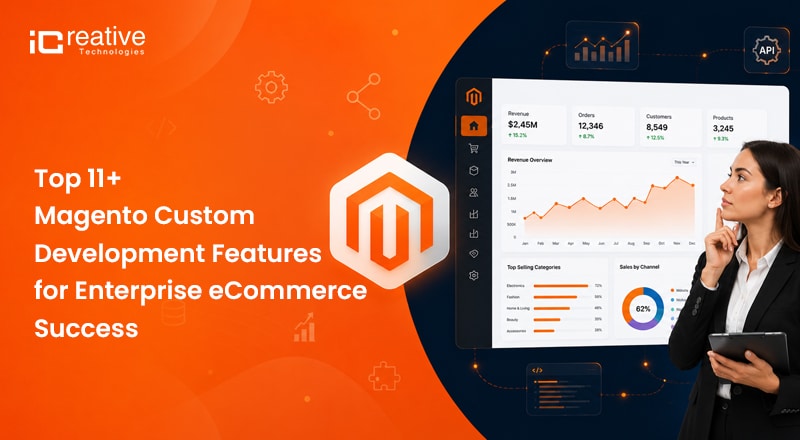
Top 11+ Magento Custom Development Features for Enterprise eCommerce Success
What is Magento Custom Development, Really?
The Shopware Administration Panel, commonly known as the backend, is where store owners and authorized team members manage the day to day operations of an online store.
Through the backend, users can manage products, process orders, update inventory, create marketing campaigns, configure store settings, and monitor business performance. This area is typically accessed by visiting your store URL followed by /admin.
1. Custom Checkout Experience
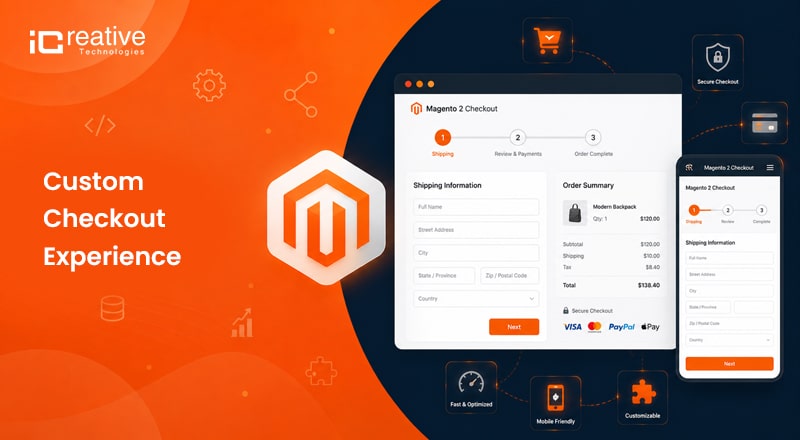
Checkout is where most enterprise stores lose money without realizing it. A generic Magento 2 checkout works fine for a small catalog, but at scale, every extra field, redirect, or payment gateway limitation costs conversions. Custom Magento development can rebuild checkout around fewer steps, address autofill, save payment methods, and support for multiple gateways including PayPal, Stripe, and region-specific processors.
Till date iCreative Technologies help 70+ Brand their Magento and Hyva Checkout optimization as trusted USA Based Magento Web Development Agency.
For B2B stores, this often means adding purchase order payment options or split shipping across warehouses, something no default Magento checkout handles well. The goal isn’t a flashy redesign. It’s removing every point of friction between “add to cart” and “order confirmed.“
Are you looking for a Magento certified agency for your store?
iCreative Technologies delivers scalable magento stores, website development, migration services, and setup solutions backed by more than 12+ years of experience.
2. AI Powered Product Recommendations

Magento’s default cross-sell and upsell modules are static. AI powered recommendation engines built into a custom Magento 2 development project use actual purchase history, browsing behavior, and cart data to surface products a customer is genuinely likely to buy, not just what’s marked as related in the catalog.
3. Advanced Search with AI
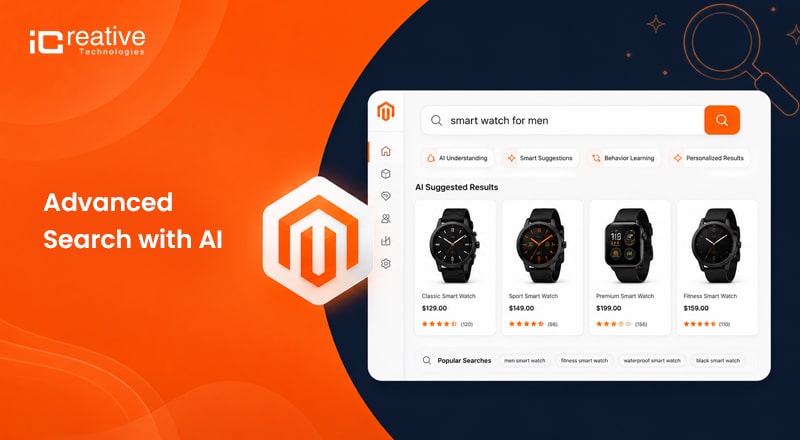
Search is often the most underinvested part of a Magento store. Custom development built on Elasticsearch or OpenSearch handles natural language queries, typo correction, and synonym recognition, so “mens running shoe” still returns the right results.
AI-enhanced search goes a step further, ranking results based on conversion likelihood rather than just keyword match, and supporting visual or attribute-based filtering like color, size, or material. With custom Magento extension development services or agencies you can integrate AI into Magento.
Advanced search features may include:
- Predictive search suggestions
- Autocomplete
- Natural language search
- Voice search support
- Personalized search results
- Image-based search
- Dynamic filtering
These enhancements create a smoother shopping experience while helping customers discover products more efficiently.
4. Personalized Customer Dashboards
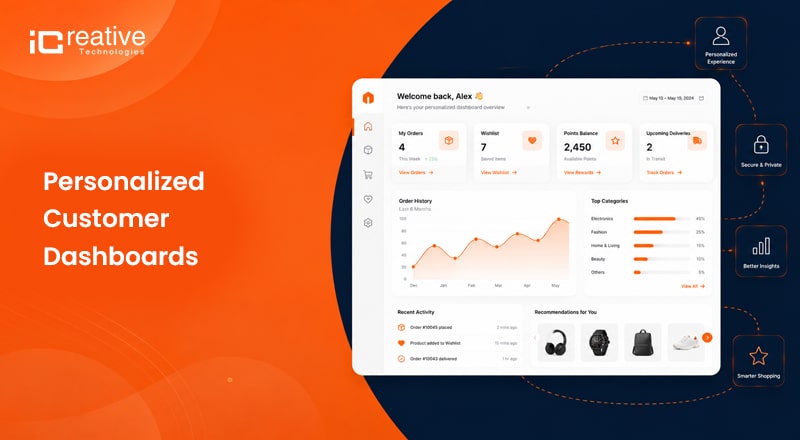
A logged-in customer should see more than a generic order history page. With the help of the right dedicated and certified Magento 2 programmer or Magento partner, custom dashboards can surface saved lists, reorder shortcuts, loyalty status, tracked shipments, and account-specific pricing all in one place.
For B2B accounts specifically, this becomes the hub where buyers manage multiple sub-accounts, track the approval status of pending orders, and reorder past purchases in just a couple of clicks.
Depending on your business model, dashboards can include:
- Recent orders
- Saved shopping lists
- Reorder functionality
- Invoice downloads
- Company users
- Approval requests
- Product recommendations
- Reward points
- Support tickets
Instead of searching through multiple pages, customers can manage their entire purchasing journey from one centralized location.
5. Dynamic Pricing & Customer-Specific Pricing
Magento B2B development agency supports tiered and customer-group pricing out of the box, but most enterprise pricing structures are more complex than the default handles.
Custom logic can apply contract pricing per account, volume discounts that scale automatically, and region or currency-specific price rules.
If you are looking for a Magento payment integration solution provider usa or Magento 2 Payment Gateway Integration Services Expert, iCreative Technologies is one of the most trusted partners. With a 98% client success rate, we help brands seamlessly integrate secure payment methods into Magento and Hyvä stores, ensuring a smooth and reliable checkout experience.
Hire Dedicated Magento Developer at Cost-Effective Pricing!
Get certified Magento 2 developers on demand for custom development, migrations, integrations, performance optimization, and ongoing support.
6. B2B Company Accounts & Purchase Approval Workflow

Company accounts with multiple buyers, spending limits, and multi-step approval chains are core to serious B2B ecommerce. Custom development can set rules so a junior buyer’s order over a certain threshold automatically routes to a manager, while smaller orders go straight through.
This kind of purchase approval workflow is one of the biggest reasons Magento remains the top platform for B2B ecommerce. It’s genuinely difficult to replicate on platforms not built for this level of account complexity.
7. Custom Inventory & Warehouse Management
Managing multi-warehouse fulfillment can quickly become complex. That’s why many eCommerce businesses rely on experienced Magento developers or certified Magento partners.
Custom Magento development can enable real-time inventory allocation based on customer location, automated low-stock alerts, and backorder logic that prevents the same product from being sold from multiple warehouses at once.
8. Custom Reporting and Analytics
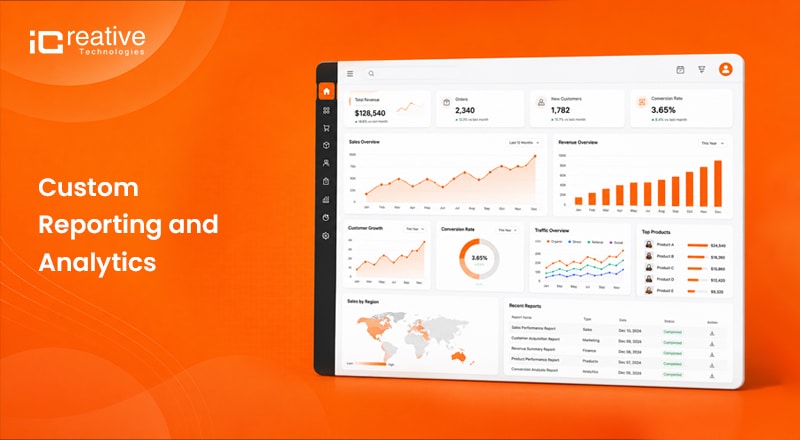
Data is essential for making informed business decisions. Custom Magento development can help create tailored dashboards that provide the specific insights your business needs. It can also integrate with business intelligence and data analytics tools for deeper analysis.
Custom reports can help you track key performance metrics, customer behavior, inventory trends, and more. For example, you can create reports that show top-performing products by category, customer lifetime value, and other valuable business insights.
9. Multi Store & Multi Language Management
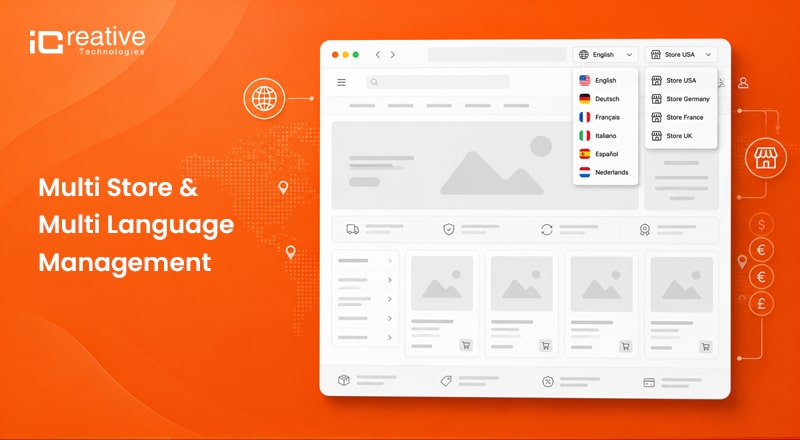
Running several storefronts, whether by brand, region, or language, from a single Magento backend can reduce operational overhead by up to 40% compared to managing separate eCommerce platforms.
Custom development sets up centralized catalog and order management while letting each store maintain its own pricing, currency, tax rules, and localized content.
Good localization is more than translated text.
Studies show that 76% of online shoppers prefer buying from websites in their native language, making localization a key factor in improving conversions.
10. Subscription & Recurring Orders
Running several storefronts, whether by brand, region, or language, from a single Magento backend can reduce operational overhead by up to 40% compared to managing separate eCommerce platforms.
Custom development sets up centralized catalog and order management while letting each store maintain its own pricing, currency, tax rules, and localized content.
Good localization is more than translated text.
Studies show that 76% of online shoppers prefer buying from websites in their native language, making localization a key factor in improving conversions.
11. Advanced Promotions & Loyalty Programs
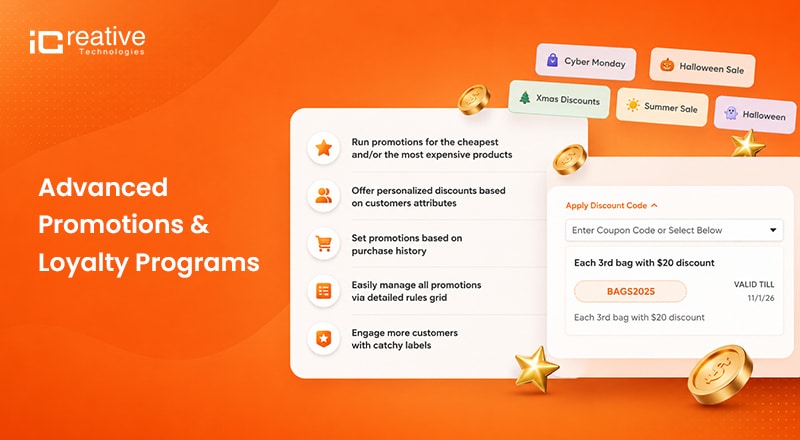
Magento’s built-in cart price rules cover basic percentage or fixed discounts. With Magento development services, businesses can go beyond standard promotions by implementing tiered loyalty points, referral rewards, and bundle pricing that accounts for profit margins instead of applying the same discount to every order.
loyalty programs built into a custom Magento development project reward customers who generate the most repeat revenue, rather than offering broad discounts that unnecessarily reduce profit margins.
Bonus ! API-First & Headless Commerce Development

Decoupling the storefront from Magento’s backend, often through GraphQL, lets a team rebuild or iterate on the frontend without touching core commerce logic underneath.
This composable commerce approach is increasingly common in enterprise Magento development, particularly for brands running multiple storefronts or channels off a single backend.
Case Studies: Custom Magento Development in Action
Let’s look at some real-world use cases of how custom Magento development has helped businesses grow:
Custom Magento Development for a USA D2C Fashion Brand
A direct-to-consumer fashion brand based in California came to us with a Magento store that looked fine but converted poorly on mobile, where most of their traffic came from.
Checkout took too many steps, product filtering was clunky on smaller screens, and page load times were dragging on collection pages with heavy imagery.
The custom build focused on three things:
- One-page checkout with saved payments.
- Mobile-optimized product filters.
- Lazy loading and optimized images.
Results after launch:
- Mobile conversion rate increased by 31%
- Average page load time on collection pages dropped from 4.2 seconds to under 2 seconds
- Cart abandonment during checkout fell by 18%
Custom Magento Development for a USA B2B Industrial Equipment Supplier
An industrial equipment supplier based in the Midwest was running a Magento store that only supported single-tier pricing, which didn’t match how their actual customers bought.
Distributors, contractors, and direct buyers all needed different pricing and different account structures, and the team was managing exceptions manually through spreadsheets and phone orders.
Custom development introduced company accounts with role-based purchasing permissions, tiered pricing by customer group and order volume, and a purchase approval.
Results after launch:
- Repeat B2B order volume increased by 52%
- Manual order processing time dropped by roughly 60%
Magento Extensions vs Magento Custom Development: Which One Do You Actually Need
| Criteria | Extensions | Custom Development |
|---|---|---|
| Best for | Standard features, quick launches | Unique business logic, complex workflows |
| Upgrade risk | Higher, especially with multiple extensions | Lower when built to Magento coding standards |
| Upfront cost | Lower | Higher |
| Long-term cost | Can increase with licensing and conflicts | Predictable and fully owned |
| Performance | Varies; some extensions add page bloat | Optimized for your specific use case |
Tips
Rule of thumb: if two or three magento extensions from the Marketplace solve it cleanly, use them. If you’re customizing extensions to the point where they no longer update safely, it’s time to build custom.
Performance and Security Aren’t Optional
Custom code that isn’t performance-tuned just moves the bottleneck somewhere else. The stack that matters most in 2026: Hyvä Theme for frontend speed, Redis for caching, Varnish for full page cache, a CDN for static assets, and real attention to Core Web Vitals since they now directly affect both conversion and search rankings.
On security, patch discipline matters more than people think. The CosmicSting vulnerability affected roughly 75% of Adobe Commerce and Magento sites in 2024.
Custom modules built without following Magento’s security guidelines, role-based access control, and regular Adobe security patches are the most common way stores get breached, not the platform itself.
How to Choose a Magento Development Partner in 2026
- Actual enterprise Magento projects in their portfolio, not just small storefronts
- Adobe certifications on the team, not just the company
- Transparent, itemized pricing
- A support plan after launch, not just a handoff
- Security awareness baked into their process, not bolted on after a breach
At iCreative Technologies, this is how every engagement starts, with a discovery conversation and technical audit before any development plan gets written. The team has delivered 2,000+ ecommerce projects across 14+ countries, holds Hyvä Theme technology partner status and Magento Association membership, is CMMI Level 3 certified, and won the Global Excellence Award for eCommerce Growth and Strategy in 2026.
Conclusion
Custom Magento development isn’t about chasing every feature on a checklist. It’s about closing the specific gap between what your store does today and what your business actually needs it to do, whether that’s B2B pricing complexity, checkout friction, or a warehouse system that can’t keep up with order volume.