

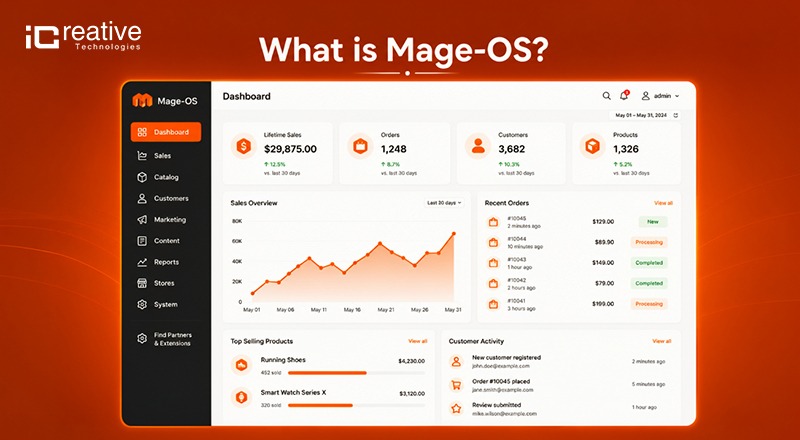
TL;DR
Mage OS is a free, open source distribution of Magento, built and governed independently by the nonprofit Mage OS Association rather than Adobe. It stays fully compatible with existing Magento 2 themes, extensions, and APIs, so most stores can migrate without losing their current setup.
Key points:
- Mage OS is a community driven fork of Magento Open Source, not a separate platform built from scratch
- It carries no licensing fees, unlike Adobe Commerce
- Releases ship faster and more transparently, with priorities set by contributors rather than a single vendor
- Existing Magento 2 extensions and themes generally continue to work after migration
- It suits businesses that want continued innovation on the Magento core without enterprise licensing costs
- Adobe Commerce remains the better fit for businesses that specifically need its built in
Introduction
MageOS, more formally known as MageOS, is an independent, community driven distribution of Magento Open Source. It gives merchants and developers an alternative path forward for the platform, one that is not controlled by a single vendor.
The project was created in response to growing concerns from the Magento community about the pace of updates, transparency, and long term direction of Magento Open Source Under Adobe commerce. MageOS keeps the core compatible with the Magento ecosystem while letting the community drive improvements, fixes, and new features.
In this guide, you will learn what MageOS is, how it compares to Magento Open Source and
Adobe Commerce, who it is built for, and what migrating or adopting it actually involves.
What is MageOS?
Mage-OS is an open initiative to ensure the accessibility, longevity, and success of the Magento® platform and ecosystem. It includes an eCommerce product.
MageOS (or Mage-OS) is an independent, community-driven distribution of Magento Open Source. Created as a fork, it is managed and governed by the non-profit Mage-OS Association to provide faster security updates, modernize the technical stack, and remove dependencies on Adobe credentials.
In other terms MageOS is an open source ecommerce platform built as a fork of the Magento core. It is maintained as an independent, nonprofit distribution that is not affiliated with Adobe or Magento. The code remains fully compatible with the wider Magento ecosystem, meaning existing themes, extensions, and integrations continue to work.
The Origins of MageOS
MageOS began as a community initiative formed by developers, agencies, and merchants who wanted a faster, more transparent way to evolve Magento Open Source. Rather than waiting on a single company’s roadmap, the project set out to build a parallel distribution
that anyone could contribute to.
Did You Know?
Mage-OS is a 100% community-owned, open-source e-commerce platform. It is a direct evolution and upstream-compatible alternative to Magento Open Source.
Why was the MageOS Project Started ?
On September 14, 2021, an open letter about the future of Magento was shared with the ecommerce community. The letter was signed by 1,641 merchants, developers, agencies, and Magento users who rely on the platform for their businesses and careers.
- An open letter signed by 1,641 Magento community members called for a clearer future for Magento Open Source.
- Adobe Commerce began focusing on composable and cloud-based microservices, which are mainly designed for large enterprise retailers.
- Many merchants and developers still prefer Magento’s traditional monolithic architecture because of its flexibility and proven reliability.
- There was growing concern that Magento Open Source lacked a clear product roadmap and long-term direction.
- The community felt there was more attention and marketing around Adobe Commerce than Magento Open Source.
- Developers and merchants wanted greater transparency, communication, and involvement in the platform’s future.
- A gap started to grow between Adobe and the Magento Open Source community due to concerns about contributions and decision-making.
- Several key Adobe leaders and Magento contributors left the organization, creating uncertainty about future open-source investment.
- The community wanted an independent, community-driven platform that could continue to evolve without relying solely on Adobe’s priorities.
- MageOS was established to preserve the open-source spirit of Magento and give the community a stronger voice in its development.
How is Mage-OS helpful?
MageOS aims to solve several challenges faced by Magento Open Source users while keeping ecommerce platforms flexible and community-driven.
Key benefits of MageOS include:
- Easy migration between MageOS and Magento Open Source.
- Businesses can continue using the platform even if Magento Open Source is no longer actively developed in the future.
- MageOS encourages collaboration with the Magento community, Magento Association, and Adobe.
- Most Magento 2 extensions and integrations work with MageOS, making adoption easier.
- Developers have more opportunities to contribute and influence the platform’s future.
- A lightweight package option helps improve performance and reduces unnecessary complexity.
- Community-driven updates allow faster bug fixes and platform improvements.
- Over time, these enhancements may provide advantages over standard Magento Open Source.
- Merchants can easily move from Magento Open Source or Adobe Commerce to MageOS with minimal disruption.
- Businesses maintain greater control over their ecommerce platform without being tied to a single vendor.
MageOS Mission and Community Goals
The mission behind MageOS is straightforward. Keep Magento Open Source alive, healthy, and actively improving, while putting the people who use it every day in charge of its direction. The project values speed, transparency, and compatibility above everything else.
The History Behind MageOS
1) Magento Open Source Evolution
Magento has long been one of the most widely used open source ecommerce platforms in the world, powering stores of every size across nearly every industry
2) Adobe’s Acquisition of Magento
When Adobe acquired Magento, much of its strategic focus shifted toward Adobe Commerce, its enterprise paid product. This shift left many open source users wondering how much attention the free, community edition would continue to receive.
3) Community Concerns and Challenges
As development slowed and communication around the open source roadmap became less frequent, developers and agencies who relied on Magento Open Source began organizing to find a sustainable path forward.
4) Birth of the MageOS Initiative
Out of these conversations, a group of contributors formally launched MageOS as a fork of the Magento core. Today it operates under the nonprofit MageOS Association, which oversees governance and ensures the platform serves the community rather than a single
Company.
How MageOS Works: Architecture, Governance, and Development Process
Open Source Governance Model
MageOS is governed by the nonprofit MageOS Association rather than a corporation. This structure keeps decision making accountable to the broader community of contributors and users instead of a single shareholder driven roadmap.
Community Led Development
Anyone can contribute to MageOS through GitHub, from small bug fixes to major performance improvements. This open contribution model is one of the platform’s defining characteristics.
Release Management Process
MageOS tracks the official Magento repositories and merges relevant updates into its own codebase, while also accepting independent community contributions that may never appear in Magento itself. Releases are issued on a transparent schedule with public release
notes.
Long Term Vision for the Platform
The long term goal is to give Magento Open Source a sustainable future. By keeping the core upstream compatible while adding innovation through the community, MageOS positions itself as a serious long term option rather than a short lived side project.
Key Features of MageOS: What Makes This Open Source Ecommerce Platform Unique
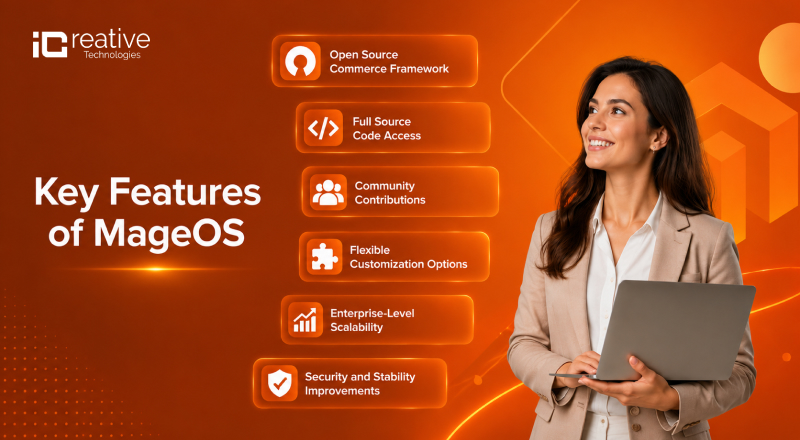
Open Source Commerce Framework
MageOS provides a full ecommerce framework covering catalog management, checkout, customer accounts, and order processing, all under an open license.
Full Source Code Access
MageOS provides a full ecommerce framework covering catalog management, checkout, customer accounts, and order processing, all under an open license.
Community Contributions
Improvements come directly from the people using the platform. This includes agencies, freelance developers, and merchants who submit fixes and features based on real world needs.
Flexible Customization Options
Because the source code is fully open, businesses and magento developers can customize MageOS as deeply as their project requires, without licensing restrictions getting in the way.
Enterprise Level Scalability
MageOS is built on the same proven Magento foundation that already powers large scale stores, meaning it can scale from a small catalog to a high volume enterprise operation.
Security and Stability Improvements
The project regularly ships security patches and stability fixes, often moving faster than waiting on a single vendor’s release cycle, while also incorporating upstream Magento
security updates.
MageOS vs Magento Open Source: Key Differences, Features & Which is Better in 2026?
| Feature | MageOS | Magento Open Source |
|---|---|---|
| Governance | Community-Driven | Adobe-Managed |
| Licensing | Open Source | Open Source |
| Roadmap Control | Community-Controlled | Adobe-Controlled |
| Contributions | Community-First Development | Adobe-Directed Contributions |
| Transparency | High | Moderate |
Core Similarities
Both platforms share the same underlying Magento codebase. MageOS is built directly from Magento Open Source, so the core architecture, database structure, and general functionality remains closely aligned.
Major Differences
The biggest difference is governance and pace. MageOS is run by an independent nonprofit and community contributors, while Magento Open Source remains under Adobe’s direct control.
Community Ownership vs Corporate Ownership
MageOS is owned and directed by its community through the MageOS Association. Magento Open Source remains a product managed within Adobe’s broader commercial Strategy.
Release Strategy Comparison
MageOS issues frequent, transparent releases with public notes and a roadmap shaped by contributor input. Magento Open Source release timing is determined internally by Adobe.
Ecosystem and Extension Compatibility
MageOS is designed to remain compatible with the existing Magento extension and theme ecosystem, so most existing Magento 2 extensions continue to function without major
Changes.
MageOS vs Adobe Commerce: What Merchants Need to Know?
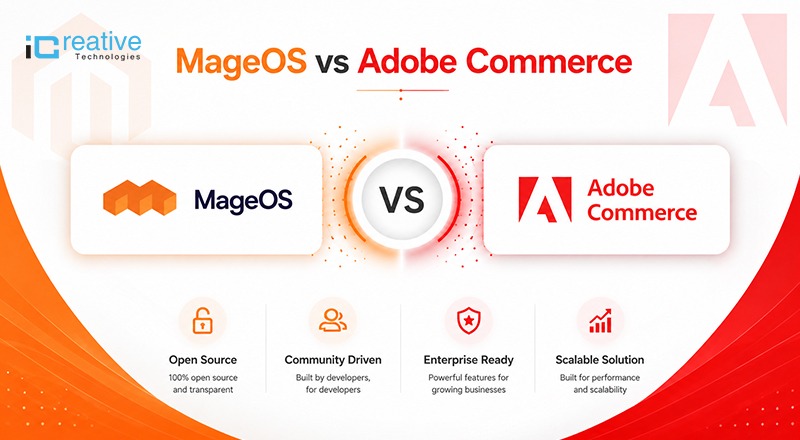
As many ecommerce brands are talking about the newly emerging Magento-based open-source platform, MageOS, it is also important to understand the key differences between MageOS vs Adobe Commerce before choosing the right solution for your business.
| Comparison Factor | MageOS | Adobe Commerce |
|---|---|---|
| Licensing Cost | Free and open source with no licensing fees | Paid enterprise platform with licensing costs based on revenue and business size |
| Core Features | Essential ecommerce functionality with community-driven enhancements | Advanced built-in features including merchandising tools, B2B capabilities, and AI-powered analytics |
| Customization | Highly flexible with access to source code and open ecosystem extensions | Extensive customization options with enterprise-grade tools and integrations |
| Scalability | Supports large catalogs and high-traffic stores using Magento-based architecture | Enterprise-ready scalability with additional built-in performance and cloud capabilities |
| Support | Community support, documentation, and certified MageOS partners | Official Adobe support included with licensing |
| Ownership & Control | Fully community-driven with complete platform control | Managed by Adobe with a vendor-controlled roadmap |
| Development Costs | Lower total cost of ownership due to zero licensing fees | Higher total cost due to licensing and enterprise infrastructure requirements |
| Best For | SMEs, startups, growing ecommerce brands, and cost-conscious businesses | Large enterprises requiring advanced features, security, and dedicated vendor support |
| Ecosystem | Open-source community ecosystem with growing partner network | Mature enterprise ecosystem backed by Adobe and global solution partners |
| Ideal Choice When | You want flexibility, lower costs, and community governance | You need enterprise features, SLAs, and official vendor support |
A Magento Open Source store often requires ongoing developer maintenance, security updates, server management, and extension support costing $500–$5,000+/month depending on complexity. A well-optimized MageOS store eliminates licensing fees while providing enterprise-grade flexibility, allowing businesses to invest more in growth rather than platform costs.
Why Are Businesses Considering MageOS?

Reduced Vendor Dependency
Choosing MageOS removes reliance on a single vendor’s roadmap and pricing decisions, giving businesses more independence over their ecommerce platform.
Greater Community Control
Decisions about the platform’s direction are shaped collectively, meaning businesses using MageOS has a genuine voice in how the platform evolves.
Cost Efficiency
Since MageOS carries no licensing fees, businesses can put more budget towarddevelopment, design, and growth rather than platform costs.
Open Innovation
New features often reach MageOS faster than they would through a single vendor’s internal process, since any contributor can propose and build improvements.
Long Term Sustainability
With an established nonprofit structure and an active contributor base, MageOS offers a credible long term path for Magento Open Source users who want continuity.
MageOS for Magento Developers
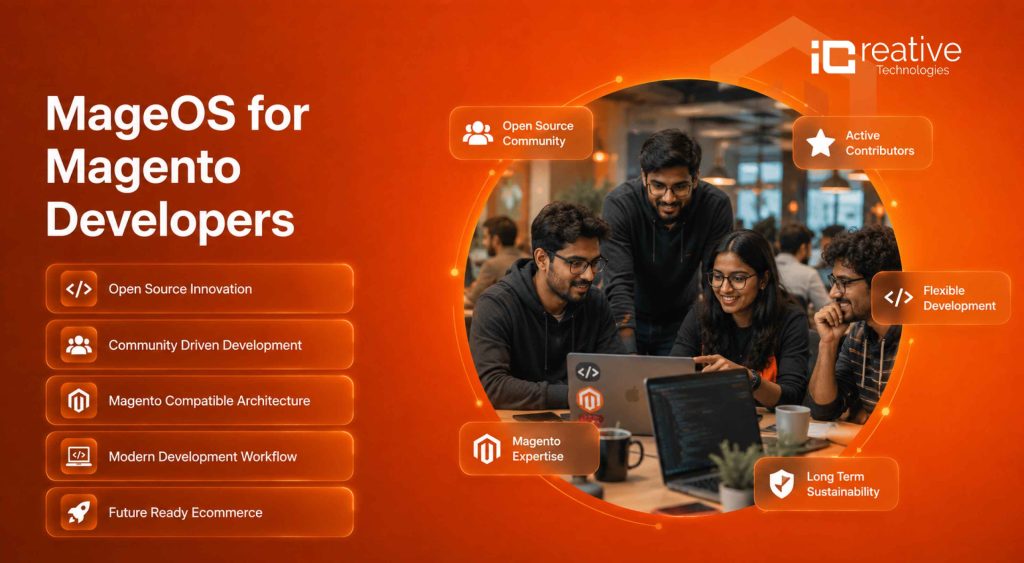
- Developer Friendly Architecture
MageOS keeps the familiar Magento architecture that developers already know, so there is
little to relearn for teams experienced with Magento 2. - Contribution Opportunities
Magento 2 Developers can contribute anything from documentation updates to core performance improvements, with contributions reviewed openly through GitHub. - Assuming plugins transfer
All MageOS repositories are hosted publicly on GitHub, where developers can open issues,
submit pull requests, and follow ongoing discussions about the platform’s directio - Creating Extensions and Integration
Because MageOS remains compatible with the Magento extension ecosystem, developers
can build new magento extensions or adapt existing ones using familiar patterns and tools. - Development Workflow
Most development workflows used for Magento 2, including Composer based dependency
management and standard testing practices, carry over directly to MageOS projects.
MageOS for eCommerce Store Owners
MageOS offers several advantages for ecommerce store owners. Built on the Magento 2 ecosystem, it provides the flexibility, scalability, and customization capabilities that merchants have relied on for years.
Some key benefits of MageOS for store owners include:
- No licensing fees, reducing the total cost of ownership.
- Full access to the source code for complete customization.
- Community-driven innovation and transparent development.
- Compatibility with many Magento 2 extensions and integrations.
- Flexibility to scale as your business grows.
- Freedom from vendor lock-in and proprietary restrictions.
- Access to a growing network of developers, agencies, and technology partners.
Is MageOS Compatible with Magento Extensions?
Yes, MageOS is designed to be highly compatible with Magento 2 extensions. Since MageOS is based on Magento Open Source, most Magento 2 themes, extensions, and integrations work without requiring major modifications.
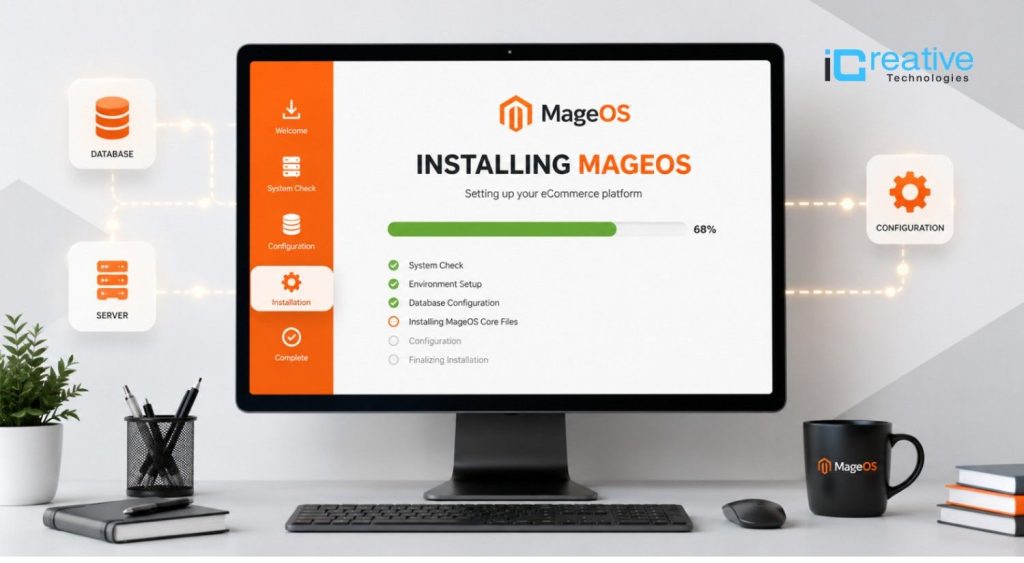
How to Install MageOS: Step-by-Step Setup Guide for Beginners
Yes, MageOS is designed to be highly compatible with Magento 2 extensions. Since MageOS is based on Magento Open Source, most Magento 2 themes, extensions, and integrations work without requiring major modifications.
System Requirements
MageOS follows the same core system requirements as the corresponding Magento Open Source version. Before installation, ensure your server environment meets the recommended specifications, including:
- Supported PHP version
- MySQL or MariaDB database
- OpenSearch for catalog search functionality
- Composer for dependency management
- Apache or Nginx web server
- SSL certificate for secure access
Always verify the latest requirements before starting your installation to ensure optimal performance and compatibility.
Installation MageOS on Your System
A fresh Mage OS installation can be created using Composer, pulling directly from the official Mage OS repository rather than the standard Magento repository.
Initial Configuration
After installation, store owners go through the standard Magento style setup wizard,configuring store details, admin accounts, and basic settings.
Post Installation Best Practices
Once installed, it is good practice to review security settings, configure caching, and set up regular backups before the store goes live.
How to Migrate from Magento Open Source to MageOS
Migration Preparation
Before migrating, review your current Magento version, document your installed extensions, and back up your full store, including the database and file system.
Data Migration Steps
MageOS provides community supported migration tooling that can switch an existing Magento installation over to the Mage OS distribution while preserving data and Configuration.
Extension Review
Check each installed extension against Mage OS compatibility notes, particularly any heavily customized or older extensions that may need adjustment.
Extension Review
Run the migration on a staging environment first, testing checkout, catalog browsing, and admin functionality thoroughly before considering a production switch.
Going Live
Once testing is complete and any issues are resolved, the final migration to production can typically be completed with minimal downtime, especially for stores that planned ahead.
MageOS Ecosystem and Community
1 ) Community Contributors
Mage OS is built by a global network of developers, agencies, and merchants who contribute code, documentation, and testing on an ongoing basis.
2) Development Partners
A growing number of agencies and development partners offer official implementation,
migration, and support services built around Mage-OS.
3) Events and Meetups
Mage OS maintains an active presence at Magento community events and meetups aroundthe world, where contributors and users connect in person.
4)Community Roadmap
The roadmap is shaped collectively, with priorities discussed openly rather than decided
behind closed doors
5) Future Growth Plans
As adoption grows, the community continues expanding tooling, documentation, and partner support to make adoption easier for businesses of every size.
Who Should Choose MageOS?
Ideal Businesses
Mage OS tends to suit businesses that value independence, want to avoid vendor lock in, and are comfortable working with an actively evolving open source community.
Ideal Development Teams
Development teams already comfortable with Magento 2 architecture will find Mage OS a natural fit, since most existing skills and workflows transfer directly.
When MageOS Makes Sense
Mage OS makes the most sense for businesses currently on Magento Open Source who want continued innovation and active maintenance without taking on enterprise licensing costs.
When Magento orAdobe Commerce May Be Better Businesses that specifically need Adobe’s built in enterprise features and want a single vendor support contracts may find Adobe Commerce a better fit.
The Future of MageOS
Upcoming Releases
MageOS continues to ship regular releases that include new features, performance improvements, and expanded tooling such as improved installers and admin tools.
Community Roadmap
Future development priorities continue to be shaped through open community discussion rather than a closed internal process.
Growth Expectations
As more businesses look for alternatives to single vendor platforms, adoption of Mage OS is expected to continue expanding across both small and enterprise level stores.
IndustryAdoption Trends
Agencies and development partners are increasingly offering Mage OS as a standard option alongside Magento Open Source and Adobe Commerce when advising clients on platform strategy.
The iCreative Technologies Approach to MageOS
As Adobe Certified Magento Partner Looking Beyond the Status Quo!
iCreative Technologies has built its reputation as one of the leading Adobe certified Magento development companies in the USA, working with merchants across the USA,Germany,Netherland,France and globally. That position comes with a responsibility. Staying ahead of platform shifts is not optional for an agency that businesses trust to make the right technology decisions for the long run.
This is the same instinct that led iCreative to adopt Hyvä themes early, well before they became the default recommendation across the Magento ecosystem. While much of the industry waited to see how Hyvä would settle, iCreative’s development team was already building, testing, and delivering Hyvä based storefronts for clients, giving them faster sites and lower long term maintenance costs ahead of the wider market.
Conclusion
Mage OS is a community driven, open source alternative built directly on the Magento foundation businesses already trust. It keeps the compatibility teams rely on while putting development decisions back in the hands of the people actually using the platform.
Compared to Magento Open Source, Mage OS offers faster releases and full transparency. Compared to Adobe Commerce, it offers a path free of licensing costs, while still scaling to enterprise level demand.
Whatever stage your store is at, understanding how Mage OS fits into the broader Magento ecosystem puts you in a stronger position to choose the right platform for where your business is headed next.
If you are looking for a Hyvä Theme specialist, Hyvä developer, or a Magento development partner for your brand, iCreative Technologies is a trusted Magento development agency in the USA. As a proud Bronze Partner of Magento Open Source and a Bronze Partner of Hyvä Themes, we deliver high-performance Magento and Hyvä solutions tailored to your business needs.
Frequently Asked Questions About MageOS
Not exactly. Mage OS is an independent fork of Magento Open Source, built to remain compatible with the Magento ecosystem while being governed separately from Adobe.
It was created to give Magento Open Source a more
transparent, community led path forward, addressing concerns about slower updates under
Adobe.
It depends on priorities. Mage OS offers
faster community driven updates and full transparency, while Magento Open Source
remains tied to Adobe's broader product strategy.
Yes, most Magento Open Source stores can
migrate to Mage OS using available migration tools while keeping their existing extensions
and themes
es, Mage OS is completely free and open source
A global community of developers, agencies, and merchants
contribute to Mage OS, overseen by the nonprofit Mage OS Association.
Mage OS is built to remain compatible with the
broader Magento ecosystem, and many stores running Hyvä on Magento 2 can run it on
Mage OS as well, though it is worth confirming compatibility for your specific setup.


