


For the past decade, getting found online meant showing up in Google Search. You optimized your product titles, wrote good descriptions, got some backlinks, and customers clicked through.
That model still works , but it’s no longer the whole game.
Today, a growing number of buyers aren’t typing into a search bar at all. They’re asking an AI assistant. “Find me industrial-grade screws under €50, in stock, with next-day delivery.” And the AI whether it’s ChatGPT, Perplexity, Google’s AI Mode, or something embedded in a company’s procurement system goes out, checks multiple stores, compares options, and either recommends one or completes the purchase on its own.
That’s Agentic Commerce. And whether your store is ready for it determines whether you get found, recommended, and bought from ?
This guide covers what it actually is, how it works step by step, how to make your store AI-readable, which protocols matter, what the security and legal risks look like, and how to start preparing today.
What is Agentic Commerce?
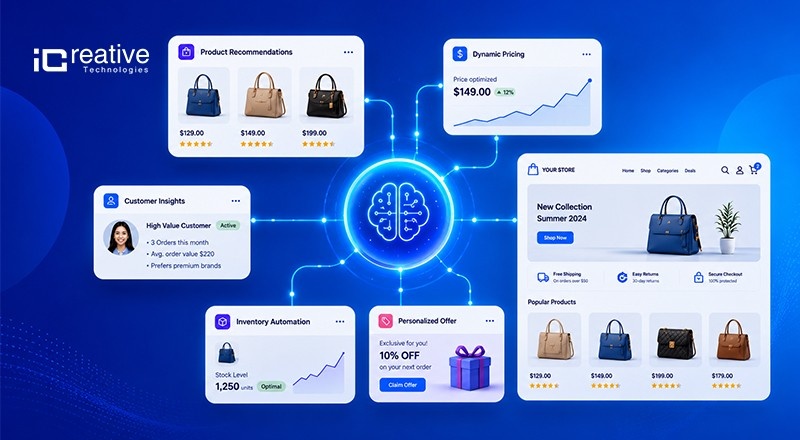
Agentic Commerce refers to an innovative ecommerce model where software programs execute step-by-step processes using AI-powered automation. An AI agent acts as a virtual assistant or virtual companion based on Large Language Models (LLMs) that performs tasks such as finding product suggestions, helping users compare products, and assisting in buying decisions.
One of the best examples is Perplexity’s “Buy with Pro” and Amazon’s “Buy for Me.” These AI-powered agentic commerce solutions help users compare products and make purchasing decisions within the platform itself.
According to the Agentic Commerce Market Analysis 2026, the market is growing rapidly across healthcare, real estate, ecommerce, travel, and financial services, with strong growth expected by 2035.
Leading ecommerce development agencies such as iCreative Technologies’ ecommerce development services help businesses integrate similar AI solutions into ecommerce stores. iCreative Technologies is a highly recognized and award-winning ecommerce development agency in the USA, offering full-stack ecommerce development solutions and services like Shopware development, Magento development, PrestaShop development, and Hyvä theme development.
Their proficiency in complex AI integrations for ecommerce stores and AI solution development expertise makes them a top choice for AI development Company in the USA and India.
How AI Shopping Agents Actually Work?
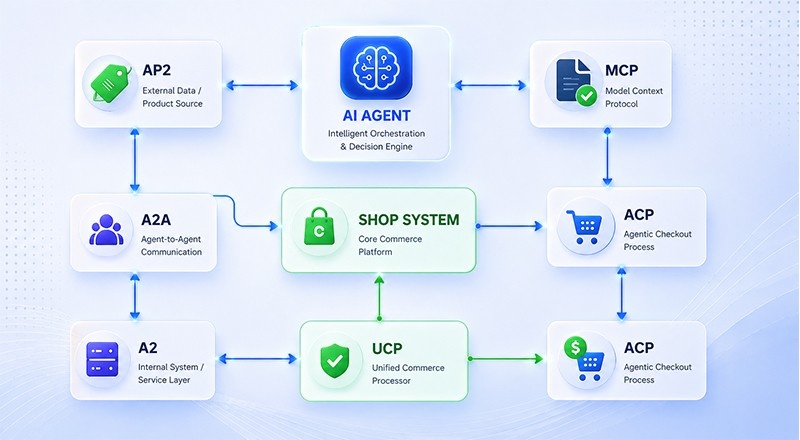
Generally, Agentic Commerce works with human activity along with independent artificial intelligence actions that involve multiple phases in the process.
Phase 1: The User Gives Instructions
The buyer or, in B2B, a procurement manager gives the AI agent a brief. This might be as specific as “order 500 units of this SKU from our usual supplier” or as open as “find the best noise cancelling headphones under $200 with Prime delivery.”
The agent stores these constraints and starts working.
Phase 2: Product Discovery and Comparison
This is where your store either gets considered or doesn’t.
The AI searches across multiple sources including indexed product catalogs, shopping feeds, APIs, and its own training data. It looks at availability, price, delivery time, return policy, and reviews. It prioritizes structured and machine readable data because that is what it can reliably parse and process.
If your product data is incomplete, inconsistently formatted, or locked behind a slow loading page without an API, the agent may skip your store entirely even if your product is the best match.
Phase 3: Decision Making
The agent compares the available options based on the user’s preferences and requirements.
It can either recommend the best choice with proper reasoning or, in fully autonomous mode, automatically select the product and continue with the purchase process.
Phase 4: Transaction
Transactions are an important part of Agentic Commerce. Purchases are completed using secure payment systems like Google’s Agent Payments Protocol (AP2), AI powered payment authentication from Visa, and Stripe’s in-app checkout integration in ChatGPT.
Phase 5: Post-Purchase
After a successful purchase, the AI agent takes care of other tasks such as shipment tracking or managing returns.
Traditional vs Agentic Commerce: The Future of AI-Powered Ecommerce
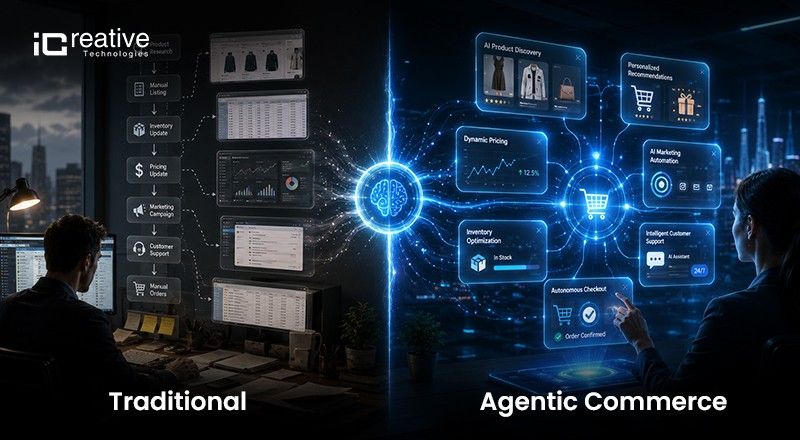
| Factor | Traditional Ecommerce | Agentic Commerce |
|---|---|---|
| Who discovers products | Human browsing/searching | AI agent scanning catalogs and APIs |
| Decision-making | Human, often emotional | AI, criteria-based and fast |
| Checkout | Human-driven | Automated or one-click |
| Key optimization target | SEO, UX, conversion rate | Structured data, APIs, schema markup |
| What wins sales | Good photos, reviews, branding | Accurate data, availability, correct attributes |
| Payment | Manual card entry or saved card | Tokenized, agent-authorized payment |
| Post-purchase | Customer tracks manually | Agent handles tracking and returns |
| B2B procurement | Mostly manual or EDI | Fully automated agent-driven purchasing |
How to Improve Store Visibility for AI Agents
Not all ecommerce stores are equally readable by AI systems. Most stores are still at the basic level, while only a small number are fully prepared for the future of AI driven commerce.
Level 1: Basic Visibility
This is the starting point where your store can appear in Google search results.
To reach this level, your store should have:
- sitemap.xml
- robots.txt
- basic product schema markup
- fast loading pages
This helps with traditional SEO, but it is not enough for AI driven discovery.
Level 2: Machine Readable Store
At this level, your store can share data with external systems and shopping platforms.
This includes:
- Store API or product API
- clean and consistent SKUs
- product feeds for Google Merchant Center
- real time inventory updates
This helps comparison platforms and AI shopping systems understand your products more accurately.
Level 3: Fully Agent Ready Store
The highest level is Agentic eCommerce. The online shop is visible not only to search engines but also to AI assistants. The following protocols are necessary for the AI to find products, check availability, place orders, and process payments.
At this level, your store can:
- respond to AI agent queries
- support AI driven checkout flows
- provide real time pricing and stock updates
- handle returns and post purchase actions automatically
- communicate through AI compatible protocols
How to Prepare Your Ecommerce Store for Agentic Commerce
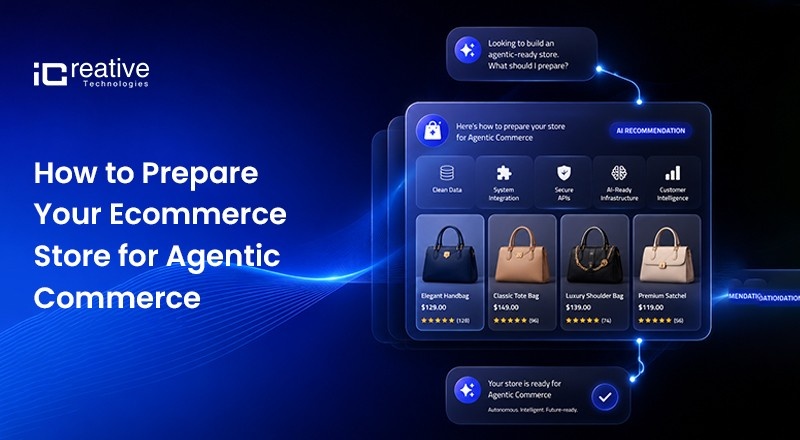
Most ecommerce stores are still not fully prepared for AI driven shopping. Businesses need cleaner product data, structured information, and better accessibility for AI systems.
Step 1: Clean Up Product Data
Good product data is the foundation for AI discovery. Make sure your products have the following information:
Step 2: Make Your Webshop Machine Readable
Schema markup helps search engines and external systems understand your products better.
Your webshop should have:
- Store API or read only API
- Unique and stable SKU/GTIN codes
- Product data that can automatically sync with advertising platforms such as Google Merchant Center
Step 3 : Make product accessible to AI Agent protocols
| Protocol | Developer | What It Does | Why It Matters for Merchants |
|---|---|---|---|
| ACP (Agentic Commerce Protocol) | OpenAI & Stripe | Handles the checkout and transaction flow between AI agents and merchants | Enables automated purchasing through ChatGPT and compatible agents |
| A2A (Agent2Agent Protocol) | Lets multiple AI systems communicate and collaborate | Allows buyer agents and supplier agents to negotiate and coordinate directly | |
| MCP (Model Context Protocol) | Anthropic | Connects AI models to external tools and data sources | Allows AI agents to query your store’s live data in real time |
| AP2 (Agent Payments Protocol) | Google + Mastercard/PayPal | Handles secure payment authorization between agents and financial systems | Makes automated checkout possible with fraud protection and audit trails |
| UCP (Universal Commerce Protocol) | Google + Shopify/Walmart/Etsy/Wayfair/Target | Standardizes the entire purchase cycle across platforms | Enables interoperability between different commerce systems and AI agents |
Real-World Use Cases for Agentic Commerce
Let’s make this concrete. Here’s how agentic commerce is showing up in practice right now.
1) B2B Procurement Automation
The manufacturer designs an AI procurement agent according to some criteria like “Order safety equipment from our list of suppliers if we have less than 10 on hand. Do not exceed €500 without managerial approval.”
This AI agent uses its ERP system for tracking the inventory and detecting low stock products, then uses the supplier’s API for getting prices and ordering goods automatically. Finally, the purchasing manager receives a weekly summary by email.
Approved suppliers receive regular orders, while suppliers that cannot integrate with AI procurement systems may lose opportunities.
2 ) Automated Inventory Replenishment
A restaurant franchise uses an AI powered system to manage supply orders. The system tracks consumption trends, predicts future demand, and automatically places orders from suppliers
If stock is unavailable, it can select an alternative supplier within the approved price range.
Suppliers with open APIs for inventory and pricing are more likely to receive these orders.
Security Challenges in Agentic Commerce!
As ecommerce becomes more AI driven, security becomes even more important.
Opening your store to AI systems also means being careful about how those systems access your data and checkout process.
API Abuse – APIs should always have proper security and rate limits. Without protection, systems can overload your store or scrape product and pricing data.
Fake AI Agents – Some AI agents may pretend to be real buyers or businesses to access pricing or test checkout systems. Secure verification and trusted integrations are important.
AI Input Manipulation – AI connected to orders or customer requests should always be monitored. Incorrect or manipulated inputs can create issues with pricing or order processing.
Payment Security – AI based checkouts use secure tokenized payments, but transactions should still be monitored carefully to prevent misuse.
Conclusion
For better growth, traditional online shops need to move beyond outdated checkout models, and in Agentic Commerce, making data understandable and trustworthy is important.
If you need AI integrations or AI solutions for your ecommerce store, our ecommerce agency at iCreative Technologies, a leading ecommerce development company in the USA, is happy to assist with AI integrations within your store.
FAQs for Agentic Commerce
Agentic Commerce is an AI driven ecommerce model where AI agents can search products, compare options, make buying decisions, and complete purchases automatically on behalf of users.
This is a standard, an open set of rules that enables trading between buyers, AI agents, and businesses.
Autonomous software solutions are transforming the retail sector, making it proactive by executing actions and tracking goals. Purchasing processes are being automated and restructured.
Yes, agentic commerce is real and already used by companies like Amazon, Google, and Perplexity. AI agents can search products, compare prices, and automate online purchases for users.
Agentic means an AI system can act independently, make decisions, and complete tasks automatically based on user goals or instructions.
Agentic AI is the broader technology behind autonomous AI systems. Agentic commerce is the use of agentic AI specifically for ecommerce, shopping, and automated purchasing.
The agentic commerce process includes:
- User gives instructions
- AI agent searches products
- AI compares prices and availability
- AI completes checkout
- AI manages tracking and returns